Decarbonisation, the circular economy, and digitalisation represent the most pressing challenges for construction professionals today. The green and digital twin transition has exposed a significant skills gap that affects both those who design and build, and those who provide training. This gap is not merely technical: there is a critical need for the ability to observe challenges from diverse perspectives, collaborate effectively across the value chain, and make decisions under uncertainty.
In Skills2Decarb, we address this need through a comprehensive capacity-building pathway aimed at both trainers (Train the Trainers) and professionals (Train the Trainees). The programme is structured around five core thematic areas: four technical domains (Carbon Neutrality, Circularity, Energy Design & BIM, Smart Readiness of Buildings) and one dedicated to soft skills (specifically targeting Trainers).
Soft skills serve as the transversal pillar of the programme, developed through the following framework: PROBLEM → SYSTEM → SELF → US
One Example, Four Perspectives
To illustrate the four perspectives of this framework, consider the selection of materials and technical solutions for a building with high decarbonisation targets. This choice, like many technical and economic decisions on-site, creates a ripple effect across: costs → procurement → timelines → construction methods → performance → environmental impact → maintenance → asset lifecycle.
This example has no single “correct” answer. Instead, it demonstrates how these four core competencies empower professionals to make better decisions and analyse critical issues in innovative ways, applicable to any professional context.
1. Problem Solving
From Crisis Management to Value Creation
Guiding Question: “Are we trying to fix the problem quickly, or understand it deeply enough to actually solve it?”
Under pressure on-site or during the design phase, there is a risk of treating symptoms rather than root causes. Problem Solving provides a structured methodology: identifying the issue, analysing data, uncovering root causes, generating alternatives, implementing actions, and verifying outcomes. By applying tools such as the 5 Whys, Ishikawa diagrams, the Pareto principle, brainstorming, and lateral thinking, trainers learn to guide trainees through practical case analyses.
2. Systems Thinking
Mapping Connections, Anticipating Impacts
Guiding Question: “And then what happens? Are we solving the problem, or altering the system that continues to generate it?”
In complex projects, a decision never produces just one outcome. Systems thinking shifts the focus from isolated obstacles to the interrelations within the entire ecosystem—analysing patterns, feedback loops, time delays, and leverage points. Applied to our building case, it evaluates the impact of materials by factoring in embodied carbon, durability, circularity, and Life Cycle Assessment (LCA). Here, the digital transformation plays a crucial role: data, BIM models, and simulations help anticipate criticalities and prevent late, costly modifications.
3. Leadership and Emotional Intelligence
Navigating Self and Relationships in Complex Contexts
Guiding Question: “How can I better manage myself to positively influence my environment?”
Uncertainty and pressure directly impact decision-making. Emotional intelligence enables professionals to recognise their own triggers, separate facts from interpretations, and manage stress when conflicts arise between budgets, timelines, and eco-sustainability goals. For trainers, this means learning to facilitate non-judgmental learning environments, where professionals can reflect on their operational behaviours without feeling their technical expertise is threatened.
4. Collaborative Leadership
Navigating Difficult Conversations, Trust, and Shared Decisions
Guiding Question: “How do we address differences without losing our ability to collaborate, transforming them into more robust decisions?”
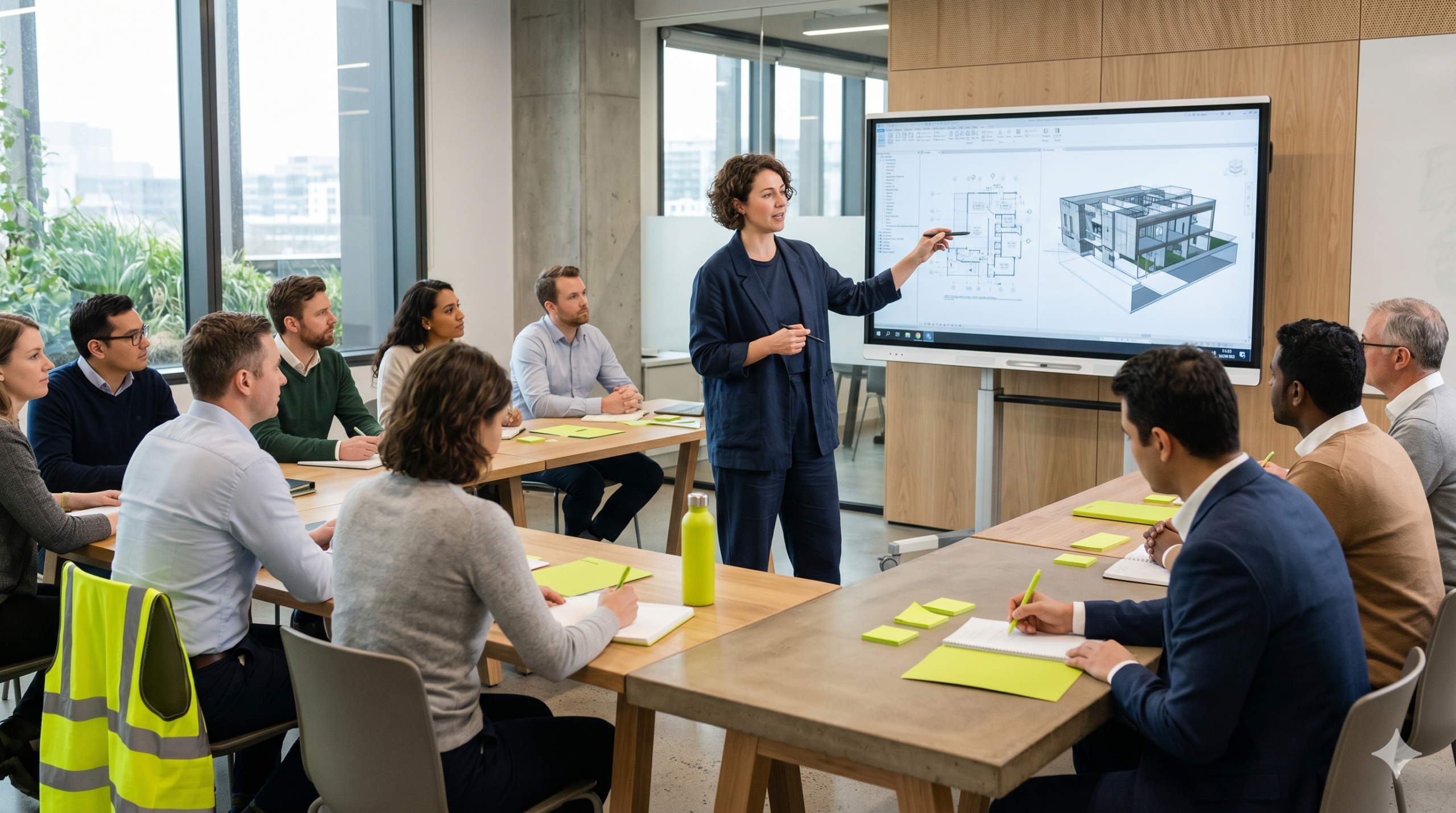
Designers, clients, contractors, suppliers, and facility managers often have divergent interests but a shared ultimate goal. Collaboration must be treated as a hard technical skill. The module covers conflict management, psychological safety, and distributed leadership. Through shared case studies, stakeholders learn to integrate diverse perspectives (costs, time, performance, carbon footprint, maintenance) to reach resilient, collective decisions.
Pathway Summary:
- Problem Solving: understanding the root problem.
- Systems Thinking: understanding the broader ecosystem and long-term impacts.
- Leadership & Emotional Intelligence: understanding one’s own role and reactions within the system.
- Collaborative Leadership: building shared decisions with all stakeholders across the value chain.