
SmarterEPC: the new hub to change building evaluation

The Energy Performance Certificate (EPC) adoption is progressing, albeit with disparities among EU Member States’ legislation. The emerging Smart Readiness Indicator (SRI) for buildings is gaining importance. SmarterEPC aims to address these challenges by providing professionals with innovative tools to standardize assessments, supported by a user-friendly hub.

The project to integrate SRI rating and energy certifications in one click just launched.

Since its launch several years ago, in Europe, the adoption of the Energy Performance Certificate (EPC) for buildings of all types is progressing well. The reference to the EPC is the Energy Performance of Building Directive (EPBD) which lays down minimum requirements for the energy performance of new buildings and existing ones that are being renovated.

The EPB Directive establishes a methodology for calculating the integrated energy performance of buildings and introduces an energy performance certification for buildings. As each EU Member State has derived specific legislation and related procedures on what to measure and how to deliver the EPCs, this has created an uneven situation in Europe: comparing EPCs for similar buildings assessed by different assessors and in different countries might be challenging. 

Another assessment for buildings is the Smart Readiness Indicator (SRI), which is being tested in several EU Member States (e.g., France, Austria, Finland, and the Czech Republic), and is expected to be paramount in the building sector in the coming years. Based on that, professional assessors are called to start getting acquainted with the SRI concept and available methodologies under definition by each EU country.

SmarterEPC to solve EPC and SRI challenges

SmarterEPC is targeting both these challenges, by leveraging on the most innovative methodologies and tools available in Europe and derived by ambitious yet validated solutions. The project aims to give support and ready-to-use tools to professionals across Europe to facilitate and make consistent the assessment and rating of EPCs and SRI for any given building. This is mainly expected thanks to the SmarterEPC hub, designed to be open, user-friendly and within reach of all professional assessors, energy auditors, building managers, and specialists in the building sector.

The SmarterEPC project is co-funded by the LIFE Programme, a European funding instrument for the environment and climate action. The project kicked off officially in October 2023 and it is going to last until September 2026. 9 companies and associations formed the project consortium. These organizations come from 8 European countries – Cyprus, Finland, France, Greece, Italy, Netherlands, and Romania – and they decided to change the field of energy certifications and smartness of buildings, to give concrete answers to the sector following EU standards, and a solid support to building owners and citizens who are not benefiting from these documents yet. 

What are the key goals of Smarter EPC:

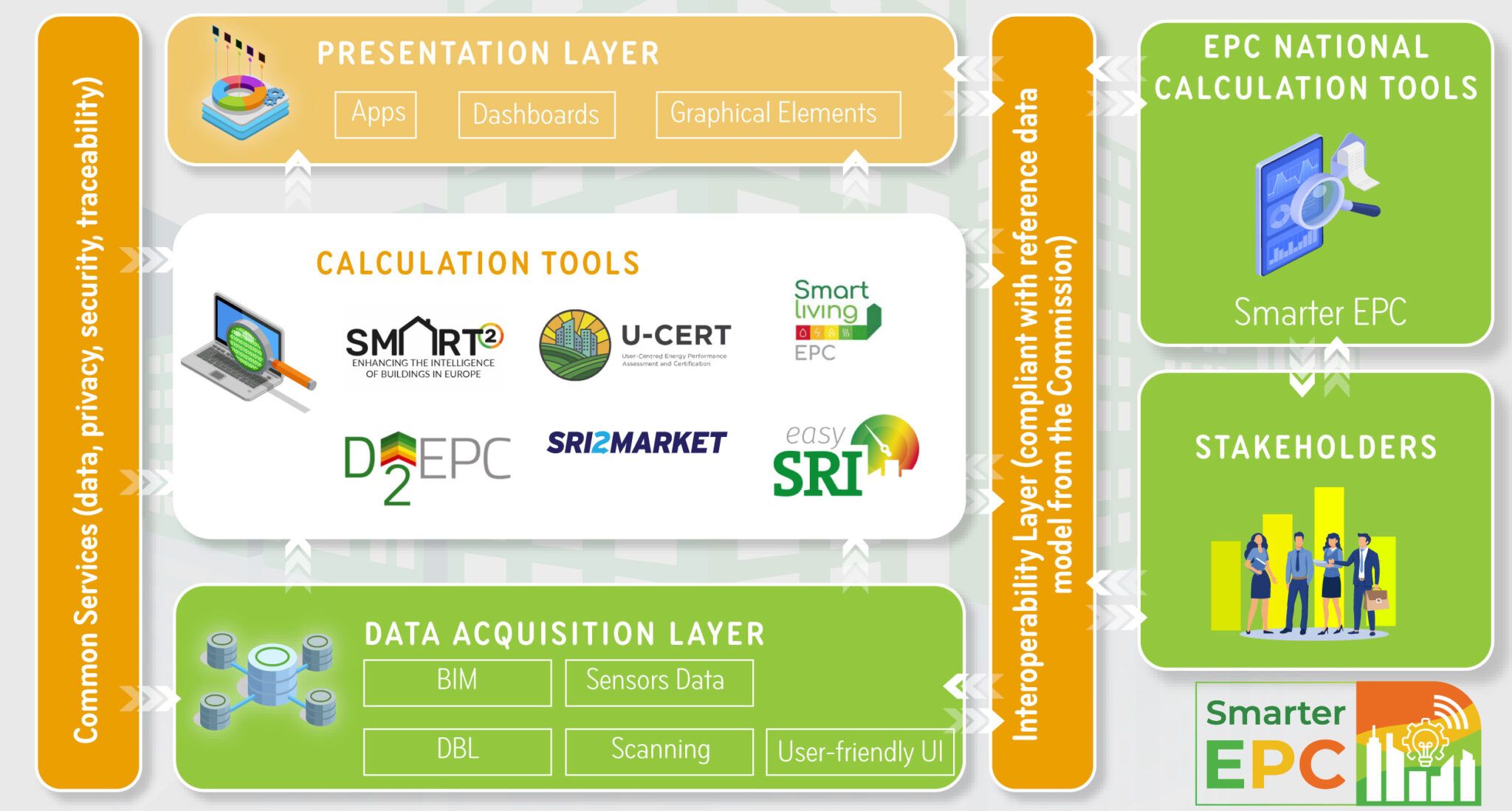
      • For the first time in Europe, assessors can access a suite of EPC and SRI calculation tools available online in one place. These tools from other R&D projects, offer elaborations based on selected criteria and are aligned with national frameworks, EN standards, and the upcoming provisions of the Energy Performance of Buildings Directive (EPBD) recast (end 2023/beginning 2024)

        • Hub’s functionality overview:
          null

        • Visualization of the results: the integrated visualization of the EPC and SRI schemes is a helpful support for assessors to make data connections (e.g. between data on the energy efficiency of the building). The assessor is also facilitated when delivering results to the client (building owner/manager, facility manager. etc.). 

        • Develop common building inspection procedures, so that EPC and SRI assessment is more efficient since the on-site data collection phase. For example, EPC and SRI ratings can be considered complementary when it comes to measuring the energy performance of a building. Hence, by setting common procedures, the assessor can focus on the building domains foreseen by the EPC and SRI only once, for a qualitative and timely-efficient result.

          • Offer common training programs on EPC and SRI. Based on the results of the SmarterEPC hub, the assessors will benefit from training modules targeted to the different aspects of these novel EPC and SRI schemes.

        Follow the activities of the consortium on the webpage and our social media channels! 
        Read more about the project

        Or subscribe to our newsletter to stay updated with the latest developments of our projects.

        By clicking Sign Up you’re confirming that you agree with our Terms and Conditions.

        SmarterEPC

        Integrating Energy Performance and Smart Readiness Indicator: Insights from assessors

        SmarterEPC surveyed 25 building performance assessors to test the integration of Energy Performance Certificates with Smart Readiness Indicator assessments. The SmarterEPC methodology promises to streamline building audits under the revised EPBD, but assessors emphasise the need for clearer criteria, practical training, and digital tools to ensure successful implementation across Europe. Read what we found out.

        Read More »
        Observe

        Some news from CIEMAT !

        On 4 and 5 November, the 2nd URBAN MOME Network Conference was held in Barcelona under the theme “Towards efficient urban environments through modelling, measurement and control in the built environment.” CIEMAT participated through its Building Energy Efficiency R&D Unit, presenting the European OBSERVE project and reaffirming its leading role within the URBAN MOME Network. Coordinated by CIEMAT, the Network provides a platform for knowledge exchange on modelling, measurement and control in the building sector, with the objective of improving

        Read More »
        EPCs in Italy
        SmarterEPC

        The state of the EPCs in Italy: progress and challenges

        The Energy Performance Certificate (EPC), introduced in Italy in 2005 with the 2002 EPBD Directive, is a fundamental tool for building management for owners, operators, and institutions alike. Aside from the benefits, what is the current state of EPCs in Italy? Every year, ENEA publishes a report on EPCs to analyze the state of the art of this certification, which is still not fully exploited in all its potential.

        Read More »
        Observe

        Some news from ENEA

        Over the past months, ENEA has been contributing to the OBSERVE project by supporting the development of a structured assessment approach to describe national building data ecosystems and inform the definition of national Building Stock Observatories (nBSO) archetypes and their key functional building blocks. ENEA has been actively involved in stakeholder engagement activities, including the collection and evaluation of inputs from national stakeholders and European policymakers. These efforts help improve the understanding of institutional needs and current practices related to

        Read More »
        Observe

        Some news from Eurac Research

        Over the past months, Eurac Research has contributed to stakeholder engagement strategies and participated in knowledge-sharing activities, including presenting synergies with related initiatives.  In parallel, we have supported the mapping of building stock data and carried out policy analysis for Deliverables D2.1 and D2.2 (project deliverables focusing on stakeholder needs) and requirements for establishing national Building Stock Observatories, and on policies and existing tools at national and EU level, respectively ensuring alignment with EU frameworks and Member State priorities.  These

        Read More »
        Observe

        Some news from Euphyia Tech LTD

        “Over the last months we had contacted Ministry of Energy Commerce and Industry of Cyprus to introduce our project and the roadmap, provide them the WP2 and WP4 questionnaires and cooperate to receive help from the lead public authority regarding our project. We had a meeting and after the meeting we received feedback from our official authority.  We received feedback with completed questionnaires and comments for projects roadmap for Cyprus and updated the partners accordingly. The comments were; Key remarks

        Read More »