Building-stock data can help public authorities monitor energy performance, understand renovation needs and track progress towards more energy-efficient buildings. But to compare information and use it effectively, countries need a common basis for collecting, organising and reporting it.
Within OBSERVE, ENEA is working with UPRC and EURAC Research to develop a reference framework for National Building Stock Observatories (nBSOs). The work builds on assessments of building-data ecosystems across the project’s six pilot countries and connects shared data requirements with procedures for data management and quality assurance.
A common dataset for more consistent reporting
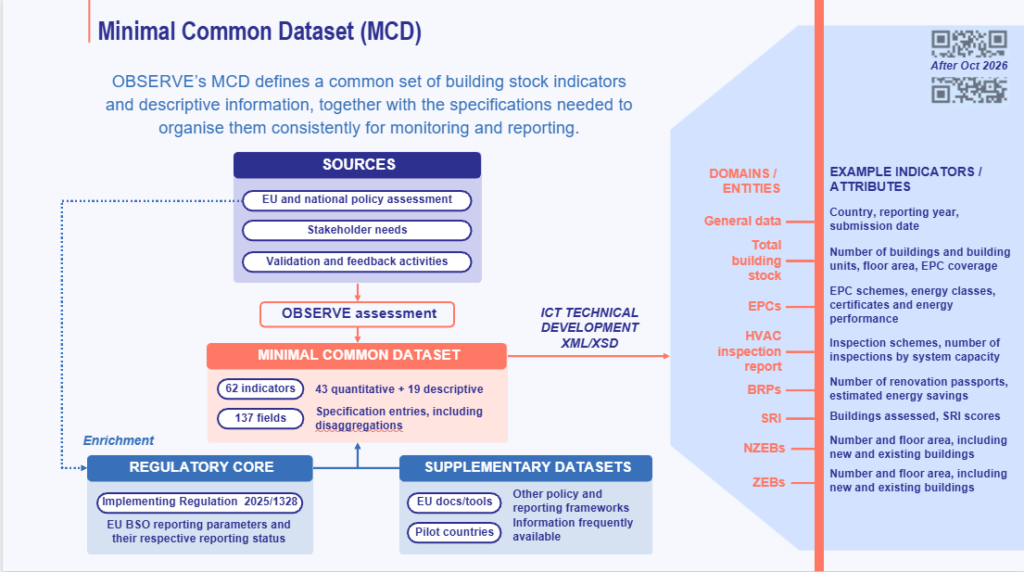
At the centre of this work is the Minimal Common Dataset (MCD), which defines a shared set of building-stock indicators, descriptive information and specifications for monitoring and reporting.
The MCD brings together 62 indicators and 137 fields, including quantitative and descriptive information as well as specifications for how data should be organised and broken down.
Its development draws on policy assessments at European and national levels, stakeholder needs, and validation and feedback activities. The dataset also builds on Commission Implementing Regulation (EU) 2025/1328, which establishes common templates for transferring information from national building energy performance databases to the EU Building Stock Observatory.
The aim is to provide a common reporting foundation while allowing countries to account for their own circumstances and additional information needs.
What does the dataset cover?
The MCD organises building-stock information into several domains, connecting general information with indicators related to the condition and energy performance of buildings.
These include:
- General data: country and reporting year.
- Total building stock: number of buildings and building units, floor area and Energy Performance Certificate (EPC) coverage.
- Energy Performance Certificates: EPC schemes, energy classes, certificates and energy performance.
- Heating and cooling inspections: inspection schemes and the number of inspections by system capacity.
- Building Renovation Passports (BRPs): renovation passports and estimated energy savings.
- Smart Readiness Indicator (SRI): buildings assessed and their SRI scores.
- Nearly Zero-Energy Buildings (NZEBs) and Zero-Emission Buildings (ZEBs): numbers and floor areas of new and existing buildings.
Together, these domains help structure information from different parts of the building sector within a shared reporting approach.
Connecting common requirements with national data systems
The MCD is one part of a wider framework being developed by OBSERVE. The infographic accompanying this update illustrates how the dataset connects to a regulatory core and supplementary datasets.
The regulatory core is based on Implementing Regulation (EU) 2025/1328 and the EU Building Stock Observatory’s reporting parameters and reporting status. Supplementary datasets can add information from other European policy and reporting frameworks, tools and sources frequently available in the pilot countries.
The framework also includes a conceptual data architecture, a standard XML Schema Definition (XSD) for data transfer, and proposed workflows for data collection, governance and quality assurance. These workflows clarify responsibilities for preparing information, reviewing its quality and correcting identified issues.
This combination is intended to connect common reporting requirements with the practical processes needed to manage and exchange building data.
From framework development to practical testing
The first stakeholder technical workshop provided feedback on the framework and helped identify priorities for further refinement. ENEA is now incorporating comments from project partners and preparing targeted consultations ahead of the second workshop.
The next stage includes testing selected workflows with representative datasets. This will help assess validation procedures, demonstrate how the proposed processes operate and identify practical limitations that should be considered when the framework is applied nationally.
The findings will contribute to recommendations for national implementation, supporting Member States as they work to develop or strengthen their National Building Stock Observatories.
Through this work, OBSERVE is bringing together shared indicators, data structures and governance procedures to support more consistent building-stock monitoring and reporting across Europe.